
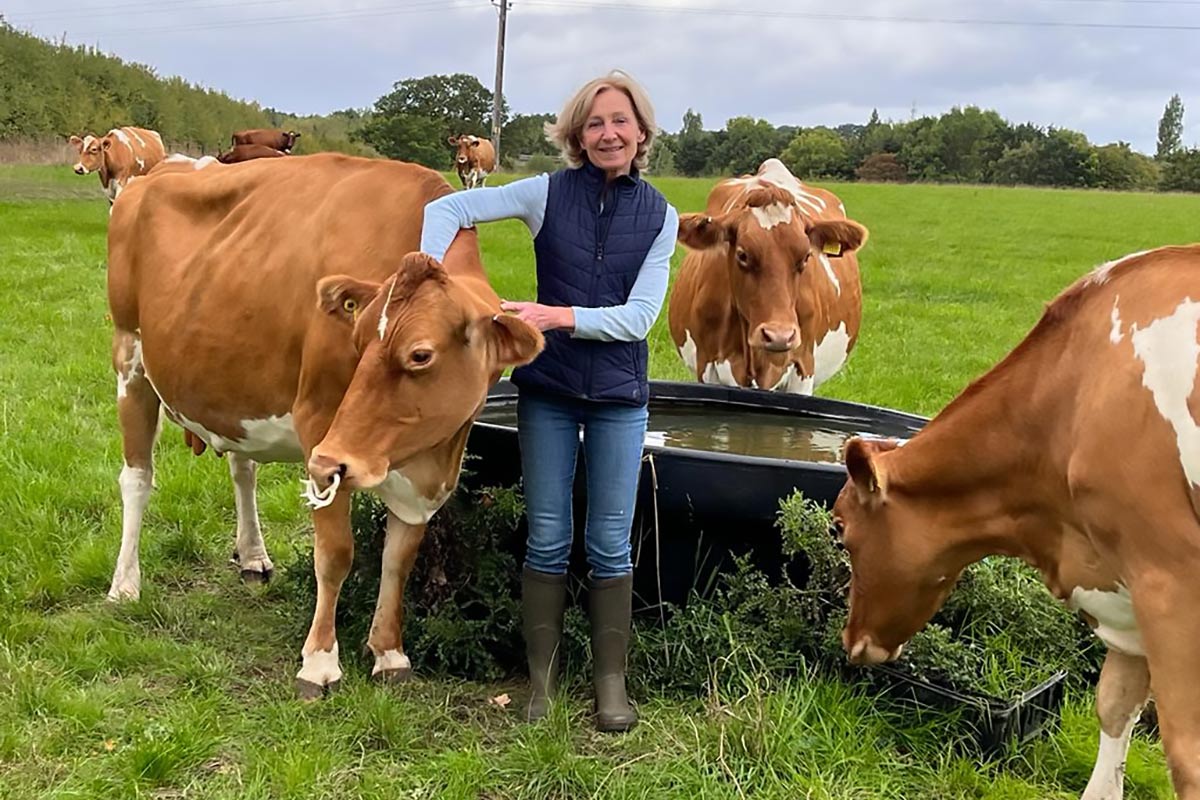
Farming for Health: How Chris' Holistic Dairy Practices Boost Animal & Soil Vitality
Chris and Nick Gosling, along with their son, own a fourth generation family dairy and arable farm on 350 acres in Wiltshire. Their Guernsey herd produces organic milk, butter and cream which is supplied to Abel & Cole, Neal’s yard, and various local shops and restaurants. They also manufacture the Biotiful range of organic kefir which is stocked by all major supermarkets. Find out more at berkeleyfarmdairy.co.uk
Although originally from a non-farming background, Chris met Nick at Agricultural College. Newly married at Nick’s family farm she started relief milking and rearing calves and soon realised this was her true vocation. She is passionate about soil health, happy cows, and holistic health approaches that work.
“I really believe that concentrating on the health of the farm and the animals is the way to achieve a successful and sustainable business. Providing the cows with the correct balance of nutritional food from healthy soils will ensure that they have strong immune systems and, therefore, reduce the need for any medicines.”
You Are What You Eat - from Ground to Gut
We have already established that a healthy soil is required to produce healthy plants but in addition to this we chose the correct type and variety of plants that will suit our soil, we have given up trying to grow lupins! We aim to produce a ration for the cows which is balanced as well as being healthy and nutritious. We grow barley and vetch which complement each other, the barley providing starch energy and fibre whilst the vetch adds protein. This combination is under-sown with a red clover/white clover perennial ryegrass ley to grow on for grazing or conservation. This has also avoided the need for extra cultivation.
So the cows are hopefully now receiving a healthy, nutritional and well balanced diet of mainly ruminant forage in the form of Barley, Vetch, grass, clover and herbs. This is supplemented with a small amount of organic concentrate.
The milk from the cows is processed in our own dairy into a range of pasteurised (not homogenised) milk, cream, butter, kefir, yoghurt and ghee. We hope that our customers will benefit from the health of our soil, plants and animals reflected in these products.
Caring for the Soil, here’s how we do it:
- Minimal Disturbance, Maximum Care:
While minimum tillage isn’t an option for us (heavy clay soil + blackgrass = no go), we subsoil regularly to aerate and reduce compaction. - Cover Crops that Work Hard:
A mix of mustard and red clover helps break up soil, bring up nutrients, and prevent water runoff in winter. - Herbal Leys That Thrive:
Our grass, clover and herb leys – especially chicory, burnet, and plantain – give the soil time to recover and boost biodiversity. - Organic Inputs Only:
Using manure and nitrogen-fixing plants, we avoid artificial fertilisers and keep the microbial life buzzing. - Crop Choices for Nutrition and Synergy:
We grow barley and vetch (starch + protein), under-sown with clover and ryegrass to extend grazing and avoid unnecessary cultivation.
We have already established that a healthy soil is required to produce healthy plants but in addition to this we chose the correct type and variety of plants that will suit our soil, we have given up trying to grow lupins! We aim to produce a ration for the cows which is balanced as well as being healthy and nutritious. We grow barley and vetch which complement each other, the barley providing starch energy and fibre whilst the vetch adds protein. This combination is under-sown with a red clover/white clover perennial ryegrass ley to grow on for grazing or conservation. This has also avoided the need for extra cultivation.
So the cows are hopefully now receiving a healthy, nutritional and well balanced diet of mainly ruminant forage in the form of Barley, Vetch, grass, clover and herbs. This is supplemented with a small amount of organic concentrate.
The milk from the cows is processed in our own dairy into a range of pasteurised (not homogenised) milk, cream, butter, kefir, yoghurt and ghee. We hope that our customers will benefit from the health of our soil, plants and animals reflected in these products.
Tackling Health Challenges on the Farm
- Mastitis
- Lameness
- Johne’s Disease
We’ve found practical, holistic solutions that genuinely work:
Cases of mastitis have been reduced by installing a cluster flush system to prevent cow to cow spread and by routine inspection of milking technique and parlour service. We have recently been chosen to help in a research project to determine the effect of biofilm in teat cup liners on mastitis and high cell counts and whether our circulation cleaning is efficient enough to remove biofilm.
We now use a much more strict protocol to lessen/eradicate Johnnes disease.
We are determined to act as a closed herd farm since a lot of our mastitis problems and other diseases (e.g Johnnes) in the last two were the result of buying in cows.
Our main approaches and tools to meet the health challenges of the farm are:
- Preventive: The main approach here is to reduce stress for the cows, this is the main and perhaps the only cause of disease. Quiet and gentle handling, efficient cow flow, feeding, clean water and housing are all important factors. We also use homeopathy as a preventive by putting doses of an appropriate remedy into the water troughs at stressful times. E.g. TB testing, turn out, weather changes, and also if we have a higher rate of mastitis and high cell counts.
- Homeopathy: As well as using homeopathy as a preventive treatment we use it for individual treatment. As farmers we have a responsibility to reduce antimicrobial resistance by using antibiotics far less frequently, reserving them for life or death situations. Homeopathy has really helped us to do this. It does require an understanding and correct training to use it on the farm. I completed a farm homeopathy course which taught me how to use my natural observational skills to find symptoms and detect changes in behaviour in the cows at stressful times and during illness which would lead to a selected remedy for them. I feel much more confident in using it now and know that I am treating the cows in a gentle, holistic way without side effects. I have seen it work wonders on our cows, calves, our dog and myself.The use of homeopathy can also be a selling point for our products. Our customers will know that our products are safe, free from residues and that they have come from animals that have been cared for in a holistic manner.
- Obsalim: We use this technique to fine tune the animals’ ration and management of feeding to their own specifications rather than just relying on what the computer tells us. Obsalim was devised by a French vet, Dr. Bruno Giboudeau who discovered that ruminants show certain signs on their bodies which reflect the efficiency (or, as he says, “the language”) of the rumen. A full description of the technique can be found at ruminanthealth.co.uk or Obsalim.com.I took part in a Soil Association field lab to investigate Obsalim and am presently a member of a Wiltshire Obsalim club which meets once a month to practice the method under the guidance of Edward de Beukelaer and Tony Pinkus who have formed the Ruminant Health company. As a group we have learnt the importance of a healthy rumination cycle as well as how to interpret the Obsalim signs. I am very impressed by this technique, there have been many occasions where we have been able to prevent a health problem from escalating by simply changing a part of the ration.Recently our group of weaned calves were coughing and had a white nasal discharge. The Obsalim diagnosis was that the ration was underperforming due to the insufficient transport of energy from the rumen to the animal. The limiting factor was the structural fibres. We replaced some of the silage with slightly more barley straw and within 48 hours all symptoms of illness had disappeared. The weather had suddenly changed from warm to cold nights, changing the animals nutritional requirements to stay healthy. Obsalim showed us how to manage this.
- Herbs: The herbal products we mainly use are Teisens udder mint (I haven’t found a better one) and Utresept. We use the udder mint on fresh calvers as a preventive for mastitis as well as for any udder oedema and also use it for any mastitis cases.It works by increasing the blood flow to the area. The better the blood flow the more white blood cells are available to fight the infection. The quicker these cells are mobilised the greater the chance of the cow achieving a self cure without the additional treatment with antibiotics.We use Utresept for uterine wash outs. It is a solution composed of water, orange extract, citric acid, yucca schidigera and glycerine. It’s antimicrobial power is due to a synergetic action created by a reaction between natural organic acids and natural sugars. When it is introduced into the uterus these acids and sugars combine with those naturally present in the animal to create a powerful and long lasting microbial effect. It can be used directly after calving or later when the cervix has contracted. Our vets always used to use Utresept on conventional as well as organic farms but sadly it became unavailable. Years later I discovered that the company who made it (Maribo Products) had moved to Canada. I order two bottles of concentrated solution per year which works out at about £2.00 per wash out. maribo@me.com
- Anolyte: We have recently installed an Envirolyte machine. A brine solution made with sea salt passes through an electric current and produces Anolyte. The active ingredient in Anolyte is hypochlorous acid, a naturally occurring acid which is also found in humans and animals and is responsible for fighting infections. It works by destroying pathogens by breaking their cell membranes and destroying the DNA, they are no longer able to mutate or multiply. It is safe and gentle enough to remove or wash bacteria from wounds and add to drinking water and yet powerful enough to remove mould, algae and biofilm from equipment.The Anolyte flows into a large tank and from there is dosed into another large tank filled with our own bore hole water which is used for water troughs and pressure washers in the parlour. The water in the troughs is exceptionally clean with no algae, other contaminants or biofilm. The parlour also stays very clean. We draw some Anolyte off for disinfecting other areas and use it for sterilising calf buckets and other equipment and we use it for bacterial and viral infections. We have started to use it as a replacement for copper sulphate in the foot baths. We are aiming to greatly reduce our use of chemical cleaners and disinfectants by replacing them with Anolyte and therefore reduce our environmental pollution. envirolyte.co.uk
Final Thoughts: Farming for Health Feeds Everyone
When we nurture the land and our animals in a truly holistic way, it doesn’t just improve productivity – it improves wellbeing. Our farm is proof that regenerative farming and holistic animal health aren’t just buzzwords – they’re good business, good science, and good sense.
If you’re curious about our journey or want to see our setup in action, watch our video here.